Big Walk Black Tower Puzzle Solution
The Black Tower adds a timing gate: lights pulse in a set order and the walkers must step in rhythm. The solution is to let the anchor count two full pulses, then cross on the third — do not move on the first pulse or the gate resets.
Overview
The Black Tower is where Big Walk stops holding your hand. The plate from the Red Tower is still there, but now a pulsing light gate decides when you are allowed to cross. Step on the wrong beat and the gate resets, which turns a simple walk into the first puzzle most groups actually have to solve together.
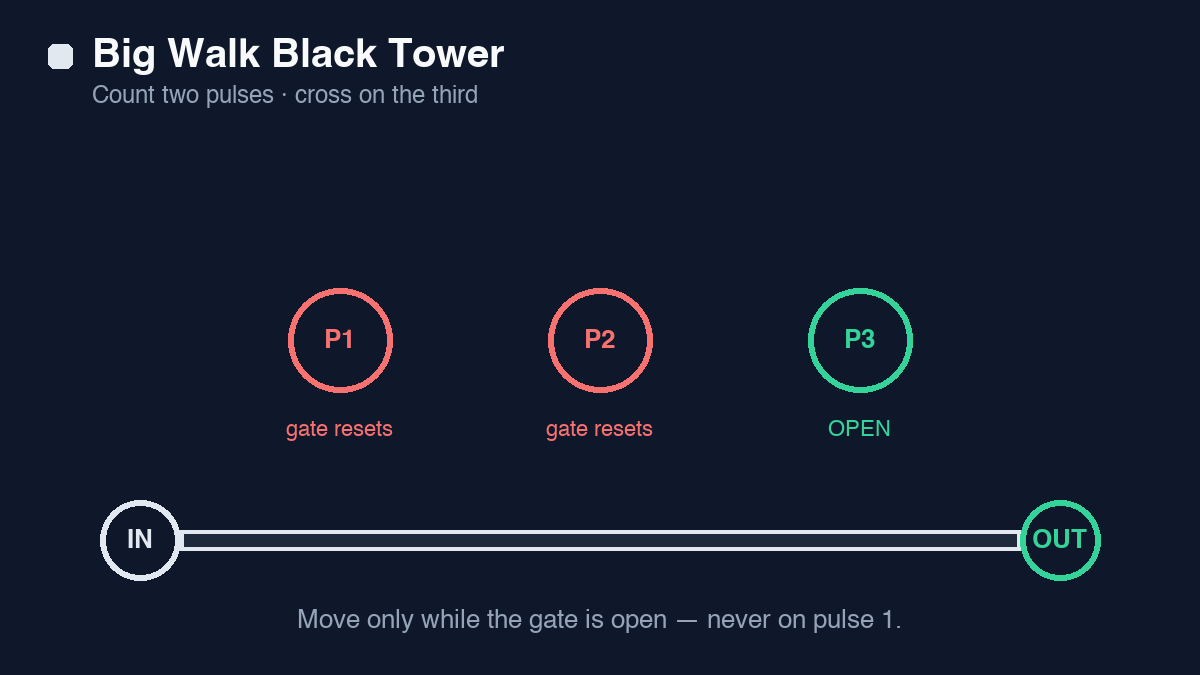
The fix is one rule: count two pulses, move on the third. Everything below is about making that rule stick when four walkers are shouting over each other.
The pulse pattern explained
The black lights at the gate pulse in a fixed three-beat cycle. The first two pulses are warning beats — they light the gate but do not open it. The third pulse is the open window, and it is the only moment a crossing registers.
Two details matter. First, the cycle never changes: no matter how many times you reset, the order is always one-two-open. Second, the gate reads your position on the beat, not your speed. A slow walker who steps on the third pulse crosses cleanly; a sprinter who launches on the first pulse resets the gate for everyone.
If the pattern feels hard to read at first, listen instead of looking: the pulses have an audible tick, and the third beat lands with a deeper tone. Many players keep the rhythm by ear once they notice it.
The timing trick
New groups panic and move on the first pulse. The gate only registers a crossing on the third pulse of each cycle, so patience beats speed. Let the anchor set the rhythm and the rest mirror it.
The cleanest method is a spoken count. The anchor watches the lights and calls "one, two, go" — with "go" landing exactly on the third pulse. Everyone else walks on "go" and ignores the lights entirely. Splitting the job this way removes the most common failure: two walkers reading the same lights at slightly different delays.
A solo timing drill
If your group keeps failing, stop crossing and drill the beat instead. Stand at the gate edge where a step would trigger the reset, and run this loop five times:
- Watch the pulses and count "one, two" in your head.
- On the third pulse, take one step forward and stop.
- Check whether the gate flashed a crossing or a reset.
- Step back and repeat until you land five clean beats in a row.
Five clean reps is enough for the rhythm to stick. It feels slow, but it is faster than another ten minutes of group resets, and once one player owns the beat they can anchor the count for everyone else.
Why groups keep resetting
Almost every failed Black Tower run comes down to the same three causes:
- Moving on the first pulse. The opening flash looks like a green light. It is not — it is the start of the count.
- Everyone reading the lights alone. Four private counts drift apart. Use one anchor and one shared call.
- Chained panic steps. One walker flinches early, the next copies them, and the gate resets mid-line. Leave a gap between walkers so a flinch does not spread.
Notice what is not on the list: the tower itself. The Black Tower never changes its pattern, so a group that resets ten times is fighting its own coordination, not the puzzle.
Black Tower vs Red Tower difficulty
The Red Tower teaches weight: keep a body on the plate and the bridge stays down. The Black Tower keeps that plate and adds rhythm on top, which is why it lands as the first real difficulty spike in Big Walk. Red forgives slow, careful play; Black punishes fast, careless play.
The skills transfer, though. A group that learned to assign an anchor in Red already has the habit the Black Tower demands — the only new muscle is counting to three before moving. Most parties clear Red on the first attempt and need two or three tries for Black, and that gap is entirely the timing gate.
Tips
- Call the count out loud in co-op so everyone moves together.
- If someone mistimes, the anchor holds and the group retries — no full reset needed.
- Watch the top walker; their position tells late joiners when the gate is open.
- Cross single-file with a gap between walkers so one early step cannot chain.
- Run the solo drill first if anyone is new — five clean beats beats ten resets.
- Ignore the walkway length; the pulse timing is identical at every crossing.
Step-by-step
- Watch one full cycle. The black lights pulse in a fixed pattern. Stand still at the gate and learn the order before anyone moves — the cycle repeats identically, so one clean watch tells you everything.
- Assign the anchor. Pick one walker to lead the count. Everyone else stays silent and follows the anchor's rhythm instead of reading the lights themselves.
- Anchor counts two pulses. The lead walker counts two full pulses out loud, then steps on the third — this is the only beat where the gate registers a crossing.
- Cross on the open pulse. Remaining walkers follow on the same open pulse, single-file, with a small gap between each walker so one early step does not chain into the next.
- Recover from a mistimed step. If someone moves on the wrong pulse the gate resets, but the run does not. The anchor holds position, waits for the cycle to restart, and calls the count again.
- Regroup at the top. Once across, hold position so late walkers can read your line and time their own crossing off the same open pulse.
Frequently asked questions
Why does the Black Tower keep resetting?
The gate resets if a walker moves on the wrong pulse. Count two full pulses, move on the third, and the gate stays open.
Can the Black Tower be done solo?
Yes — the timing is the same, you just cross the plate yourself on the open pulse. Many players actually find the rhythm easier alone because there is no second walker drifting off-beat.
Is the Black Tower harder than Red?
It adds rhythm on top of the plate mechanic, so most players find it the first real difficulty spike.
Does the Black Tower pulse pattern ever change?
No. The three-pulse cycle is fixed for the whole tower. The only thing that changes is your position — later crossings feel faster because the walkway is longer, not because the lights speed up.
How many players do you need for the Black Tower?
The puzzle scales to your party size like the rest of Big Walk. Two players is the comfortable minimum: one anchors the count while the other crosses on the open pulse.
How long is the gate open on the third pulse?
Long enough for a single-file line to step through if everyone moves on the call. It is not a reaction test — if you are already walking on the third pulse, you will make it with room to spare.
What is the Black Tower in Big Walk?
One of the five color towers in House House's co-op puzzle game. It builds on the Red Tower's pressure-plate idea by adding a timed light gate, and it is the first tower most groups have to retry.
Do you need voice chat for the Black Tower?
It helps a lot. The whole solution rests on one shared count, so a spoken 'one, two, go' is far more reliable than watching each other move. Text callouts work if they are sent early.
Related Big Walk guides
- Big Walk Red Tower Puzzle Solution: Step-by-Step + MapStuck on the Red Tower in Big Walk? Full puzzle solution with map location, the anchor-plate walk order, and the bridge trap that fails most runs.
- Big Walk Green Tower Puzzle Solution: Step-by-StepBig Walk Green Tower solution: route the beam to both receivers in the right order, extend the two bridges, and the mistakes that drop them.
- Big Walk Blue Tower Puzzle Solution: Step-by-Step GuideStuck on the Blue Tower in Big Walk? Full puzzle solution: valve water levels, the mid-state ledge rule, and the full-drain trap — with diagram.
- Big Walk Yellow Tower Puzzle Solution: Finale GuideBig Walk Yellow Tower solution: the final tower solved bottom-up — plate, beam, then water — plus role assignments and reset recovery.
- Big Walk Tools & How to Use ThemEvery Big Walk tool explained one by one — what each does, when to use it, and the combos that break puzzles.
- Big Walk Co-op / Crossplay Not Working? FixesBig Walk co-op and crossplay troubleshooting: join codes, NAT, platform limits and the Reddit-famous disconnect fixes.